


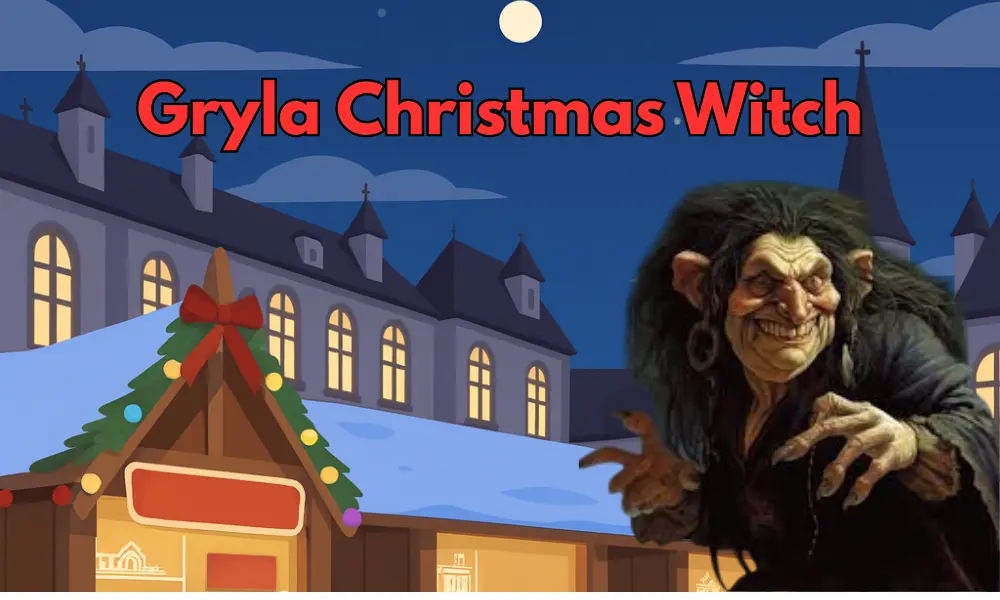
The gryla christmas witch is most one off chilling personality in European winter, which is rooted in Iceland culture. It’s a century old story, in which a demonic witch, Who roams a frozen mountain in the Christmas season. The legend says when winter nights grow longest she descends into the village to find misbehaving children. On the contrary of joyful imagery of Santa Claus. The gryla christmas witch is considered a symbol of fear, discipline, and the severe realities of survival in medieval Nordic life. This story was used by the parents as a warning to encourage obedience and hard work during a long dark winter. This is an interesting Christmas story, over the time This is proof of that reflecting how earlier societies mixed morality lessons with seasonal myths. As well as this, the character shows how Christmas folklore is not only about joy, but also about fear, respect, and consequences in a brutal natural environment.
Gryla Christmas Witch in Icelandic Folklore and Mythology
In Icelandic folklore, the gryla christmas witch is far more than a simple bedtime horror story. She is presented as an ancient being, older than Christianity itself, symbolizing chaos and punishment. It is famous that living in remote caves and lava fields, she came down every Christmas season with a sack to collect naughty children. This story is the most popular in the farming communities where obedience and cooperation were necessary to survival. The parents used this story to motivate our children to complete work before the winter storm arrives. Over generations, her character evolved, absorbing Christian moral themes while retaining pagan roots. Today he remembers that people need to adopt folklore. blending fear with moral instruction. The gryla Christmas witch’s enduring role in mythology highlights how dark legends can survive alongside joyful holiday traditions.
Gryla Christmas Witch and the Haunting Symbolism of Christmas Fear
The gryla christmas witch represents the darker psychological side of Christmas, and this is a season often idealized as purely joyful. The gryla christmas witch story reflects humanity’s fear of winter scarcity, isolation, and punishment. In symbolic words, the gryla Christmas witch incarnates nature’s cruelty during hard winters, when food was limited and survival uncertain. To reveal these dangers, ancient communities gave form to their problems. Christmas, occurring in the winter, became a time when these fears were strongest. Gryla’s legend has acted as a cultural coping mechanism for people to explain hardship through storytelling. Even today, her image reminds us that traditional celebrations have often balance light with darkness. The coexistence of warmth and terror in her myth reveals how Christmas folklore acknowledges both hope and fear within the human experience.
Gryla Christmas Witch as a Moral Enforcer for Children
Historically, the gryla christmas witch was functioning as a strict moral enforcer rather than mere entertainment. Parents had invoked her name to make sure children behaved responsibly between winter preparations. The fear of the gryla christmas witch was meant to teach discipline, respect for elders, and the importance of contributing to family survival. Without formal education systems in societies, folklore served as a powerful teaching tool. Gryla’s terrifying reputation to make sure that lessons were remembered. While modern audiences can see her as excessively cruel, her role reflected the realities of previous times. Survival depends on cooperation, and disobedience could be a danger to the entire household. Like this, her legend highlights how morality, fear, and survival were tied in traditional Christmas narratives.
Conclusion
The gryla christmas witch incarnate the shadow side of Christmas culture, which is reminding us that folklore often balances joy with fear. Her legend emerged from harsh environments where survival depended on discipline and cooperation. Over centuries, her story evolved, adapting to cultural changes while preserving its haunting core. Now a days, she stands as both a warning figure and is a fascinating cultural symbol. By understanding her origins and symbolism, we gain insight into how societies used storytelling to teach values and confront fear. The enduring presence of this dark figure proves that even in the most festive seasons, humanity has always acknowledged the power of caution, morality, and myth.












Leave a comment